A beloved ‘little’ community now faces a major milestone
A beloved ‘little’ community now faces a major milestone
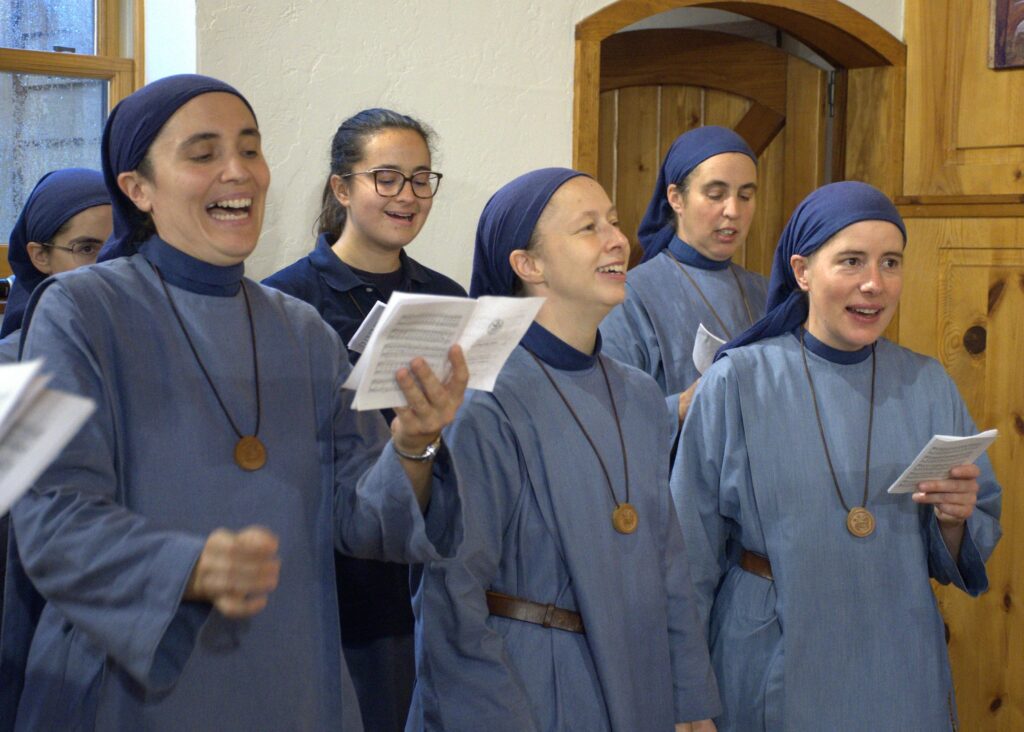
City, Kansas. Photos courtesy of The Leaven
Little Brothers and Little Sisters of the Lamb from across the globe are convening at their motherhouse in France from now until May as they encounter a significant milestone in their history.
The emerging religious organization, the Community of the Lamb, is in the process of selecting a successor for its founder, Little Sister Marie, who is still alive (members of the community prefer not to use their surnames).
The congregation of religious sisters and brothers has significantly influenced those they have met for various reasons.
It’s their “epic” spirituality expressed in small wooden homes that captivates Oscar Shingledecker, a college student from North Carolina. Their unique sung Masses, which combine the liturgies from both East and West, impressed Cathe Sienkiewicz, a mother and catechist from Kansas. Additionally, their profoundly Christ-centered mission outlook drew in Aaron Riches, a theologian who has encountered them in two different nations.
The community presently possesses “small monasteries” in France, Spain, Italy, Germany, Austria, Poland, Argentina, Chile, and Kansas, and are recognized for their mendicant way of life and their cheerful disposition, which includes staging original performances and breaking into song.
Little Sister Marie-Jeanne, 36, hailing from Paris, France, guides the sisters in Kansas City, Kansas. She shared with Our Sunday Visitor, “As Little Sisters of the Lamb, we experience the immense joy of being beggars. We travel door-to-door, two-by-two, emulating the example of the disciples and our founders, St. Dominic and St. Francis, to request something to eat.”
Concerning the smiles and melodies, she mentioned, “We find happiness in our longing for God, for in our emptiness before him, we encounter his abundance.”
The community originated in Paris in 1968, initiated by Dominican sisters who began to collectively consider the Church’s approach to fundamental inquiries like “Who is God?” and “What defines our humanity?” In 1981, the foundation was officially acknowledged by Chartres Bishop Michel Kuehn. In 1983, Perpignan Archbishop Jean Chabbert received the community into his archdiocese. Dominican Master Vincent de Couesnogle identified the order as “a new branch sprouting from the trunk of the Order of Preachers.” Since 1996, Vienna Cardinal Christoph Schönborn has served as the bishop overseeing the community.
Archbishop Joseph Naumann of Kansas City, Kansas, greeted them upon their arrival in Kansas in 2008.
“Since my initial meeting with the Little Sisters many years back in Rome, I found myself attracted to their charism of being mendicants, relying on God’s providence for all things,” he remarked.
“Each time I go to the Little Monastery, I make it a point to inquire from the Little Brothers and Sisters about their latest missions,” Archbishop Naumann remarked. “They meet numerous individuals seeking reassurance that God is present in their lives: a young woman who has maintained her sobriety for several years but is facing the temptation to drink once more on that particular day; parents who have recently endured the loss of a child; an elderly individual who feels isolated and overlooked.”
They consistently invite those who have received them to come, spend time, and pray at the monasteries. They finish by singing a blessing for those who have extended their homes and hearts to them.
A ‘Legendary’ Way of Living
Oscar Shingledecker, a second-year student at Benedictine College in the neighboring Atchison, Kansas, connected with the community during his first year and participated in their Triduum festivities, which feature an overnight vigil and a large bonfire.
Young Brother Joachim remarked to him, “Should you ever travel to France, make sure to see our monastery.” Consequently, he did. Accompanied by three friends during a semester abroad in Europe, Shingledecker explored the community on two occasions in France — at their Lyons monastery and the Saint-Pierre motherhouse, situated 10 miles from Fanjeaux, where St. Dominic once resided.

“Their motherhouse is incredible,” remarked Shingledecker. “It features multiple buildings spread across the southern hills of France and numerous areas for prayer. They had animals as well. It was stunning.”
The monasteries of the Community are recognized for their unique wooden construction. The modest homes and communal structures are frequently likened to Hobbiton in “The Lord of the Rings.”
He stated that the charism of the community is “the answer” the Church requires in the present day.
“They present a way of living that illustrates how individuals can uphold an inner life despite an ever-changing timetable,” he stated. “In contrast to other orders, their lifestyle is not rigid and structured. They remain committed to prayer, dedicated to Christ, yet they engage in a variety of activities without a fixed routine. We met a homeless individual in Lyons and prepared pigs for dinner in San Pierre.”
He remarked, “Their spiritual practice represents a magnificent blend of Dominican and Franciscan spirituality, which is truly fascinating.”
The Community holds a particular reverence not only for St. Dominic and St. Francis but also for St. Catherine of Siena, St. Benedicta of the Cross (Edith Stein), and St. Thérèse of Lisieux.
An Unusually Stunning Liturgy
Numerous individuals arrive at the Community of the Lamb for its unique liturgical practices.
At the time of their establishment, the community sought a liturgical form that responded to the directives of the Second Vatican Council. sought“The liturgy of the Council enabled us to experience the rhythm of the heart of God and His love for all humanity,” states the institute’s online history. The Mass of the Community is observed incorporating aspects of both Eastern and Western customs.
Cathe Sienkiewicz mentioned that it is the liturgy along with the presence of the sisters that renders it unique.
“The splendor arises from the profound and genuine happiness of these devoted men and women,” she remarked. “This happiness is both lively and solemn, and these attributes are conveyed in their liturgy, which is predominantly performed in exquisite polyphony.”
“It is a sanctuary of tranquility,” she stated.
“I believe that what individuals frequently pursue, yet seldom discover, is a liturgy that is purposeful, is intrinsically linked to the community, and involves the entire individual. All of these aspects unite at the Little Brothers and Sisters,” Sienkiewicz remarked.
“Individuals feel attracted to it, as an experience that satisfies a deep-seated requirement,” she stated.
Missionaries Focused on Christ
Ultimately, however, the Community of the Lamb is dedicated to spreading the Gospel through personal testimony, acts of service, and even by staging plays.
Theologian Dr. Aaron Riches from Benedictine College encountered the Little Sisters of the Lamb for the first time at their Light of Peace convent located in Granada, Spain.
“On numerous Saturdays during our time in Granada, we took our children to the monastery for the open table,” he mentioned. “When we informed Hermanita [Little Sister] Fatima about our departure from Granada to Kansas, she exclaimed — with a huge smile of happiness — that in God’s providence, we were going exactly to the one location in North America where the Community of the Lamb is present.”

Nevertheless, “There are no Little Brothers of the Lamb in Granada,” he remarked. He felt thankful to present his son to them at their “small monastery” in Kansas.
“The most impactful experience I’ve had with the community was this winter when my son and I participated in an overnight mission with two of the little brothers,” he stated. “We spent the night in a homeless shelter. We queued up alongside everyone else. We didn’t provide any tangible assistance. For 12 hours, we shared in the struggles of the impoverished. They were touched by our presence; we were even more touched by their warm reception.”
The community’s slogan, illustrated with a representation of the Lamb of Revelation, is “Wounded, I never cease to love.” The intentional recurrence of the term “little” in the community’s language–always in lowercase–is deliberate: The members aim to place Christ, not themselves, at the forefront.
Riches characterized the “smallness” of the Little Brothers and Little Sisters.
“Little Sister Marie-Jeanne addressed my class and mentioned something similar to the idea that each person carries a Bethlehem within their heart where Jesus is yearning to enter. That Bethlehem, ready for him, is not a space defined by our skills or moral excellence,” he stated, but “the hidden area we hesitate to reveal to others.” It’s in that space that Jesus “longs to enter our lives as the gentle, loving tranquility of our restoration.”
At the Core of the United States
Archbishop Naumann expressed that the archdiocese is fortunate to have this impactful testimony, yet when the Little Sisters agreed to his invitation, individuals questioned them, asking, “Why Kansas?”
“The true reason the Community of the Lamb arrived in Kansas is that they implored the Lord to direct them to the places where they were needed the most,” he remarked. “The Holy Spirit did not lead them to Washington, D.C., the capital of our nation; nor to New York City, the economic center of our country; nor to Los Angeles, a cultural nexus — but instead to the core of our nation.”

The community is happy they did.
“What I have found in the United States is the kindness rooted in the hearts of Americans,” stated Little Sister Marie-Jeanne. “It is a privilege for me to observe the naturalness and straightforwardness with which Americans offer their support and companionship.”